While both college football and the National Football League share the same fundamental objective of advancing the ball into the end zone, the rules governing these two levels of play differ significantly in ways that dramatically impact gameplay, strategy, and entertainment value. Understanding the distinctions between College Football vs NFL rules is essential for fans who want to fully appreciate the nuances of America's favorite sport at both levels.
The Foundation: Why Rules Differ
Before diving into specific rule differences, it's important to understand why these two levels of football maintain distinct rulebooks. The NCAA governs college football with rules designed to accommodate student-athletes balancing academics and athletics, while the NFL operates as a professional entertainment enterprise with rules optimized for competitive balance and viewer engagement.
The NCAA rulebook prioritizes player development, educational values, and competitive equity among hundreds of diverse institutions. Meanwhile, the NFL focuses on maximizing competitive drama, protecting franchise investments in player talent, and creating the most entertaining product possible for a massive television audience.
Pass Completion Rules: The Most Visible Difference
Perhaps the most frequently discussed and debated rule difference involves what constitutes a completed pass. This distinction creates dramatically different outcomes in seemingly identical situations and represents one of the most fundamental schematic differences between the two levels.
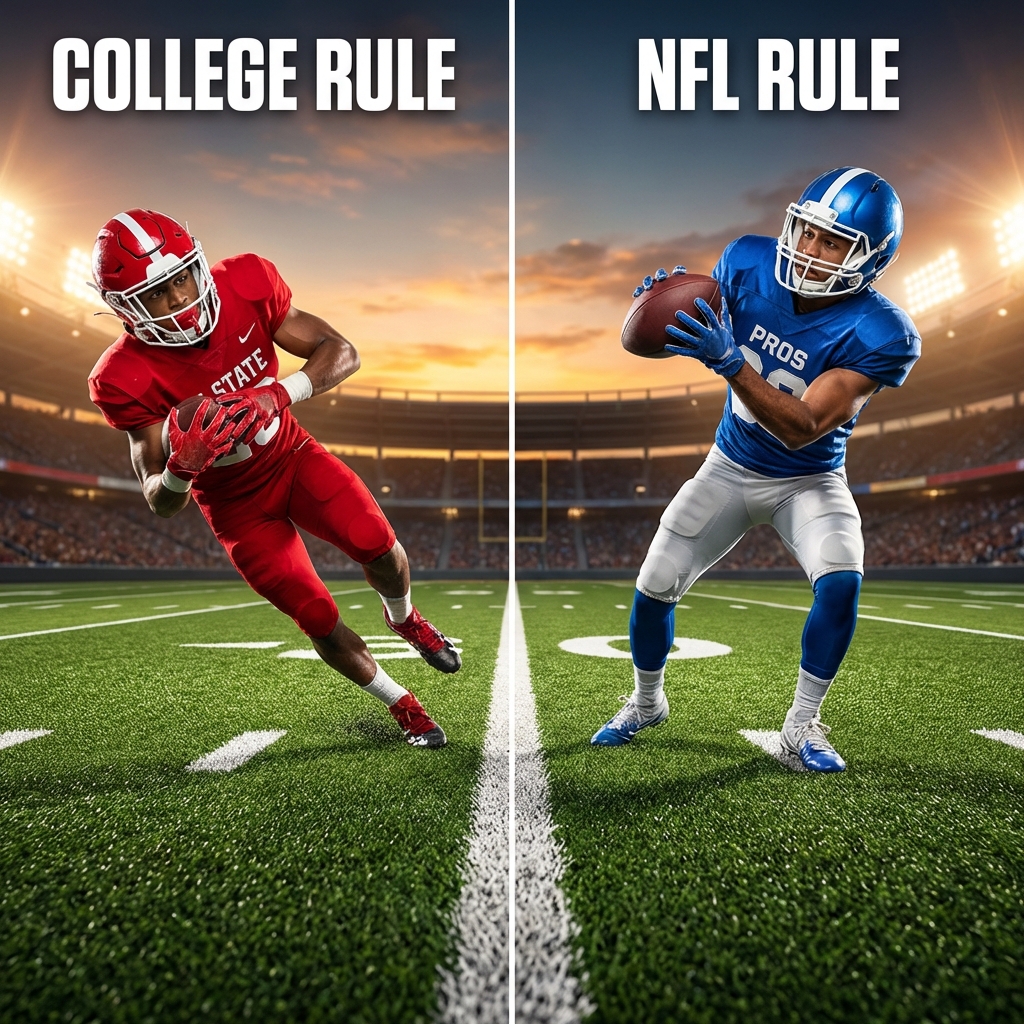
College Football: One Foot In
In college football, a receiver needs only one foot (or any body part other than hands) inbounds while maintaining possession to complete a catch. This more lenient standard makes sideline receptions easier to complete.
NFL: Two Feet Required
NFL receivers must establish possession with both feet inbounds before going out of bounds for a catch to be ruled complete. This stricter standard increases the difficulty of sideline receptions.
Timing and Clock Management
Clock rules create significantly different strategic environments at each level, influencing everything from play-calling philosophy to game duration to comeback scenarios. These timing differences fundamentally alter how coaches manage the final minutes of close games.
Clock Stoppage
College football stops the clock after every first down to allow the chain crew to reset the markers. In the NFL, the clock continues running after first downs except during the final two minutes of each half.
Player Down
When a ball carrier is tackled inbounds in college football, the clock stops momentarily. The NFL runs the clock continuously after inbounds tackles except during the final two minutes of each half.
Two-Minute Offense Dynamics
These clock rule differences create dramatically different two-minute offense scenarios. College teams benefit from automatic clock stoppages on first downs, making 70-yard drives with minimal timeouts feasible. NFL teams must either complete passes out of bounds, use timeouts strategically, or execute hurry-up offenses with remarkable precision.
Overtime Formats: Completely Different Approaches
Nothing illustrates the philosophical differences between college and professional football more starkly than their overtime formats. These systems create entirely different strategic and psychological dynamics.
Comparison Summary
| Rule Category | College Football | NFL |
|---|---|---|
| Pass Completion | One foot inbounds required | Two feet inbounds required |
| Clock After First Down | Stops until ball set | Continues running (except final 2 min) |
| Overtime Format | Alternating possessions from 25-yard line | Modified sudden death, 10 minutes |
| Player Down Rule | Player down when any body part touches | Player down when touched by opponent |
| Pass Interference | 15-yard penalty (maximum) | Spot foul (full yardage) |
| Targeting Penalty | Ejection plus potential suspension | 15-yard penalty, possible fine |
Understanding the Impact on Strategy and Entertainment
The cumulative effect of these rule differences creates two distinct versions of football that, while sharing common DNA, require different skills, strategies, and mentalities. College football's rules promote higher scoring, more dramatic comeback opportunities, and greater offensive creativity.
NFL rules emphasize field position, defensive strategy, and situational football. The two-feet catch requirement, continuous clock operation, and severe pass interference penalties create a more methodical game where execution precision determines outcomes.
Fresh 2026 notes
How to use the homepage as your football starting point
The homepage is designed to do two jobs at once. It explains why college football and the NFL feel different on the field, and it points you toward the pages that turn that knowledge into a better game-day plan. Use it as the first stop when you want a clean rules refresher and as the launch pad when you need team, schedule, stadium, fantasy, or playoff context.
Use the rules page as your baseline
The homepage exists to explain why college football and the NFL feel different in real game situations. One-foot catches, clock stoppages after first downs, overtime structure, and penalty enforcement all change how games unfold. If you understand those differences first, every team page and playoff page on the site becomes easier to read because the strategy, the pace, and the stakes all make more sense.
Treat the homepage like a route map
The page is not just an article; it is the top of the site. From here, you can jump to team hubs, schedules, stadium guides, watch-party pages, playoff scenarios, fantasy football, or college football content depending on what you need that day. A good homepage should reduce the number of clicks it takes to go from curiosity to a real plan, and this one is built around that idea.
Match your browse time to the football calendar
Early in the week, team hubs and schedules matter most. Midweek is when injuries, fantasy questions, and travel choices become clearer. On Thursday and Friday, watch-party and stadium planning usually take over. Weekend reading shifts again: college football dominates Saturday, the NFL takes center stage on Sunday, and the late-season playoff race starts rewriting which games matter most.
Use context, not just headlines
Fresh content is only valuable if it changes the way a reader acts. A rule comparison should tell you why a game feels different. A schedule should help you pick the week that needs attention. A stadium guide should help you decide when to leave, where to park, and what to bring. That practical angle is what keeps the homepage useful long after the initial publish date.
Think in next steps
Once you finish the homepage, the next step should be obvious. Team pages give you the local picture, playoff pages explain the bracket, fantasy pages help with roster decisions, and college football pages keep the Saturday side of the sport in view. The site works best when each page feeds the next one, so the homepage needs to act like a bridge instead of an endpoint.
Best for readers who want context
If you are comparing college football and the NFL, this page gives you the rule differences in one place and shows why those differences matter for the rest of the site. It is the cleanest reset when you want the season to feel less noisy and more understandable.
Best for readers who need a next click
If you are planning a weekend, this is the page that should send you to the next decision. Use it to jump from broad football context into team pages, playoff races, fantasy lineups, or campus coverage without having to rethink where to start.
Quick checklist
- Start here when you want the college-vs-NFL rule differences in one place.
- Move to team hubs when you need schedules, records, and local context.
- Use stadium and watch-party pages before a game-day outing.
- Check playoff and fantasy pages once the season starts to shape weekly decisions.
- Return to the homepage when schedules, standings, or releases change.
- Treat the page as the top of the site, not a dead-end article.
That is the goal of the homepage: to give a useful overview, then get out of the way and let readers move to the page that answers their next question. When it works well, the site feels lighter, faster, and easier to trust.